.webp)
The Building That Couldn’t Be Budged
The Building That Couldn’t Be Budged
An Upper East Side townhouse engulfed by new construction tells a very New York story.
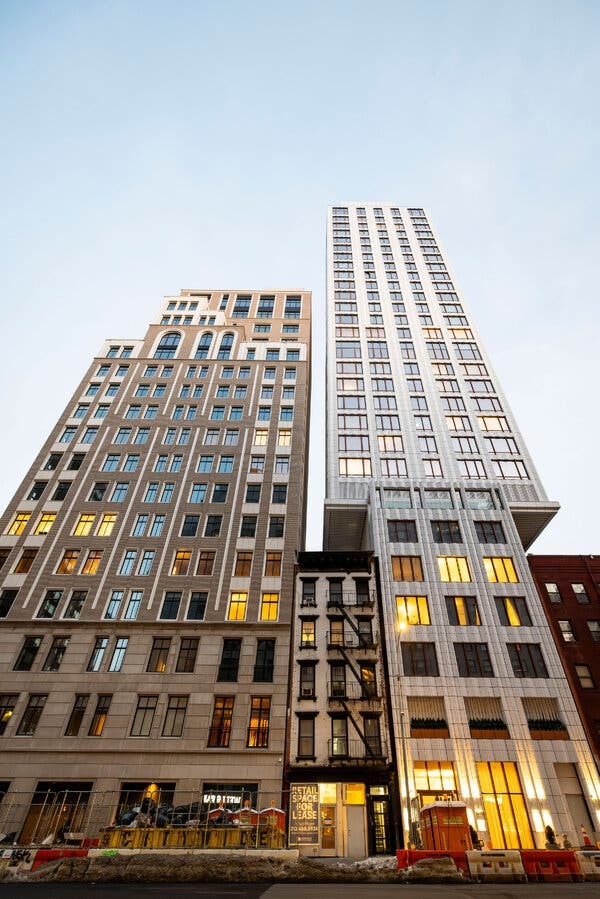
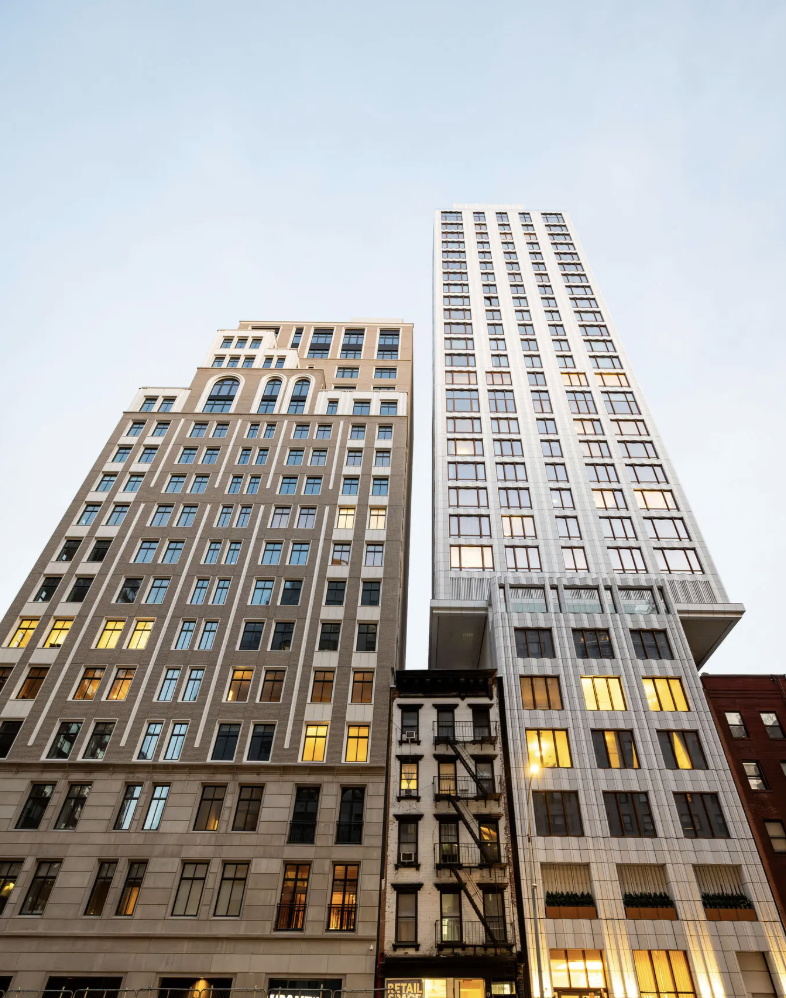
1301 Third Avenue is sandwiched between an 18-story luxury condominium and a 32-story tower.
This article is part of our Design special section about buildings, objects and techniques that are fighting to stay alive.
For generations, the residential property at 1301 Third Avenue was owned by the same family. Erected around 1910, it was a building of no particular note, a five-story, six-unit tenement in a row of nearly identical buildings, itself little different from countless other rows throughout the city.
Today, the building still stands, under new ownership and in a much-altered condition. Immediately to the north, 1301 is now perfectly flush with the far taller 200 East 75th Street, an 18-story luxury condominium designed by Beyer Blinder Belle. On the southern flank, yet another recently completed tower, the 32-story 201 East 74th Street from the office of Pelli Clarke & Partners, looms larger still.
And not only that. The Pelli Clarke structure — currently being marketed by its developer, the Elad Group, as The 74 — cantilevers over its aging neighbor, clearing the top of its decorative cornice by 22 feet and nearly kissing the Beyer building on the other side. Fully subsumed into the urban fabric, the building gives the impression of an ancient shrub, lorded over by a pair of jumped-up saplings.
“It’s bizarre,” said Ari Rosenberg. A nearly two-decade resident of the Upper East Side, Mr. Rosenberg once rented an apartment in one of the buildings where 200 East 75th Street now stands; living around the corner since 2014, he watched as the new construction first replaced his former abode, then engulfed the familiar facade down the street. Radical changes are no stranger to the area, which has one of the highest volumes of new condo construction in Manhattan. Nonetheless, the visual presented by 1301 Third Avenue is especially confounding.
“I’m not a real estate guy,” said Mr. Rosenberg. “I’m just like, how are they doing this? Why?”
The answer, of course, is a tale as old as New York real estate itself. “There’s a story behind every holdout,” said Andrew Alpern, the co-author, with Seymour Durst, of the 1984 book “Holdouts! The Buildings That Stood in the Way.” Mr. Alpern, who is a lawyer and architectural historian, knows most of those stories by heart: the one about the defunct department store at the southeast corner of Macy’s in Herald Square; the one about the rowhouse at Sixth Avenue and 50th Street, since painted gray beige to match Rockefeller Center. Time after time, the shape of the city has been altered by someone who, for whatever reason, refused to budge. “Sometimes it’s greed, sometimes it’s fear,” said Mr. Alpern. “You have to analyze each circumstance.”
Image
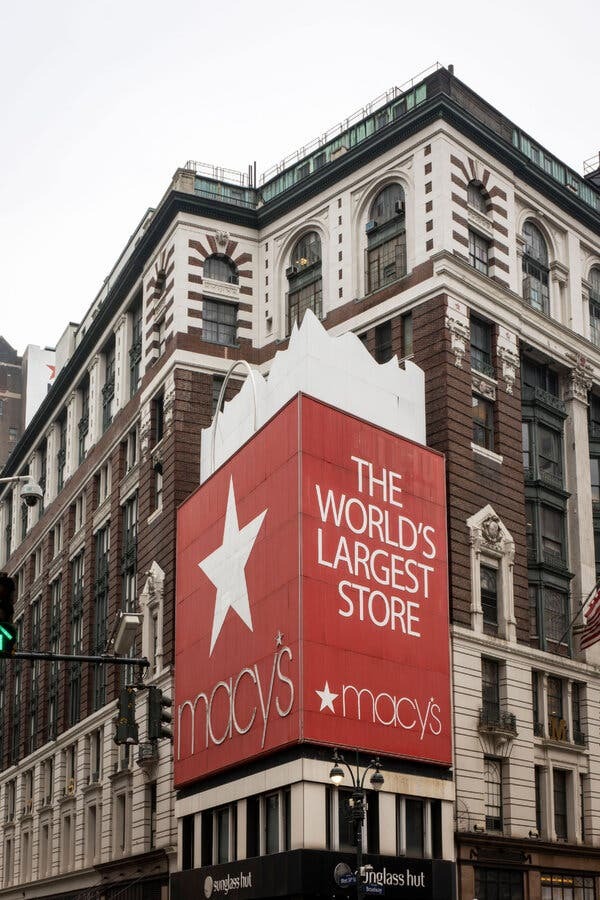
The defunct department store at the southeast corner of Macy’s in Herald Square is covered by a large billboard sign.
Credit...
Katherine Marks for The New York Times
In the case of 1301 Third Avenue, the analysis is not easily performed. “Developers don’t want to talk about demolishing buildings and kicking everybody out,” said Ada
m Leitman Bailey, a lawyer who has represented both builders and tenants in analogous situations.
The delicate gamesmanship of offers and counteroffers is purposefully shrouded in mystery; in this instance, the legal and architectural maneuvering that produced the state of affairs at 1301 is more obscure than most. The building is now owned by a corporate entity, and the previous owners could not be reached for comment. But whatever occurred, the outcome is strangely compelling: a remarkable, if somewhat awkward, example of the city’s future grafting itself onto (and over) its past.
The transformation of the western edge of block number 1429 (in Manhattan’s official designation system) actually began in 2017. That was the year Premier Equities, another real estate and investment firm, finalized the purchase of five adjacent properties on the old row, 1291-1299 Third Avenue, as well as a sixth comparable building around the corner, 204 East 75th Street. Yaron Jacobi, one of Premier’s founding partners, never indicated any intent to tear down the southernmost three structures, likely owing to a number of rent regulated tenants. (Mr. Jacobi did not respond to interview requests.)
Housing law makes it prohibitive to evict tenants without cause, and paying them to depart a building voluntarily can be costly. “Buyouts vary widely,” said Mr. Bailey, citing numbers anywhere from $20,000 up to several million. Rather than take the hit, Mr. Jacobi transferred the air rights (the amount of buildable space permissible in a given zoned area) from his other nearby holdings to the more easily emptied parcel at 1297-1299 Third Avenue, increasing the allowable height for what would become The 74.
A few years later, the owners of the buildings near the northwest corner decided to sell their properties as well. Bob Knakal, a commercial real estate veteran, facilitated that transaction, and he explained that, by the time he came on the scene, in 2020, the intransigence of 1301’s tenantry was already well established. The new owners of 1303-1309, EJS Group, made no effort to buy the single lot between their planned 200 East 75th Street project and Mr. Jacobi’s buildings. “They didn’t want to take the time to vacate 1301,” Mr. Knakal said.
Neither, evidently, did Mr. Jacobi. The developer already faced a preservationist outcry concerning an easement he claimed allowed him to create a southern entrance on 74th Street; he prevailed in that fight, and might have proceeded to build on the now T-shaped site. Yet 1301 held on, and Premier’s patience (if not, indeed, its resources) were nearing an end.
Precisely what blandishments, if any, the company had dangled before the tenement’s remaining residents is unclear. All that can be said for sure is that by 2022, Mr. Jacobi moved on to the holdout’s air rights. He then traded the complete parcel to the Elad Group in a $61 million deal, along with a fully approved plan from SLCE Architects, which called for the two-way cantilever. That left 1301 and its resolute occupants — three rent-regulated tenants (the other units were vacant), according to online documents, none of whom could be reached for comment — living in the shadow they had helped create.
The Beyer Blinder Belle design for EJS’s 200 East 75th is fairly conventional. A simple masonry-clad block with a light decorative overlay and a handsome lobby, it joins an ever-growing list of luxury Upper East Side condos harking back to the area’s august prewar architecture. The Pelli building, on the other hand, is something very different.
“We wanted to amplify the qualities, but not the style, of Manhattan Deco,” said Craig Copeland, the firm’s design principal. In view of the already approved cantilever, an ornament-laden design might have made for an odd spectacle — pilasters dangling in air, friezes doubled or cut in half. So the architects opted for a restrained, contemporary envelope clad in pleated terra-cotta panels that “create a series of regulating lines,” as Mr. Copeland put it, “almost like music.”
The solution lends unity to what remains a somewhat uncanny architectural image, the tower rising to a terrace-topped base above the seventh floor before sprouting wings and then ascending in a single, soaring shaft that juts over 1301 and 1295.
“We kept toggling between on one hand responding to the cards we were dealt, but on the other hand saying, OK, what would we want to do if we were starting from scratch?” Mr. Copeland said.
Image
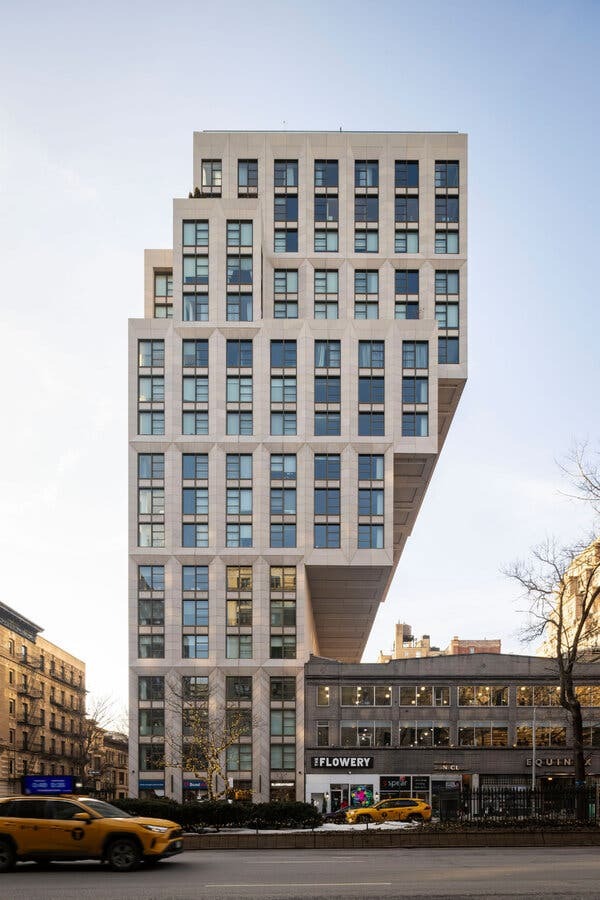
The Westly, a condominium building on the Upper West Side, hangs over its three-story neighbor.
Credit...
Katherine Marks for The New York Times
Such cantilevering has become, if not commonplace, at least more familiar. From the Upper West Side, where the Westly, a condominium building, snakes precariously over a three-story neighbor, to Crown Heights, where a stately old building is now hooded by the apartment tower One Sullivan Place, the ever-increasing value of land in New York, combined with the legal difficulties that clearing it can entail, have obliged designers and their clients to get creative.
At The 74, the whole vertical load of the upper 25 levels has to be balanced on diagonal structural members concealed within the eighth-floor slab, right above the enormous, 5,383-square-foot duplex that fronts it. Working at exactly the same time as their counterparts only a few yards away at 200 E. 75th, the building crews had to carefully coordinate on-site operations to avoid damaging each other’s structures, or the still-occupied 1301 squeezed tightly between them.
For Elad’s would-be customers, the building’s curious background and profile have proven no deterrent, and perhaps even an attraction. The company reports that nearly 75 percent of the tower’s 41 units have already been sold, fetching as much as $5.5 million for a three-bedroom. Prices at 200 East 75th Street are no less staggering, ranging up to $21.2 million for the penthouses. And though the surrounding block remains dominated by modest, relatively low-cost dwellings, including 1301, the rootstocks of the newcomers are still spreading into the urbanistic overgrowth, this time horizontally.
On the northern extension of the site, Pelli Clarke is finishing work on a four-story townhouse, the first single-family home ever completed by the firm in New York. “We were trying to appeal to the neighborhood,” said Elyse Leff, Elad’s executive vice president of marketing and sales. “The idea of a family town home really speaks to the Upper East Side.”
Whether Upper East Siders will respond in kind is yet to be seen. Mr. Rosenberg, the longtime neighborhood resident, lamented the loss of his old building — “My name was still on the mailbox,” he said — yet he described the town house’s squeezed looks as “kind of cool.”
For the tenants at 1301, the fit might feel tight. But as Mr. Alpern, the architectural historian, observed, the kind of New Yorker prepared to stick it out this long is likely the kind able to acclimate to almost anything.
“The tenant has to be a little bit eccentric,” he said. “But people do like the idea of the little guy holding out against the big guy.”